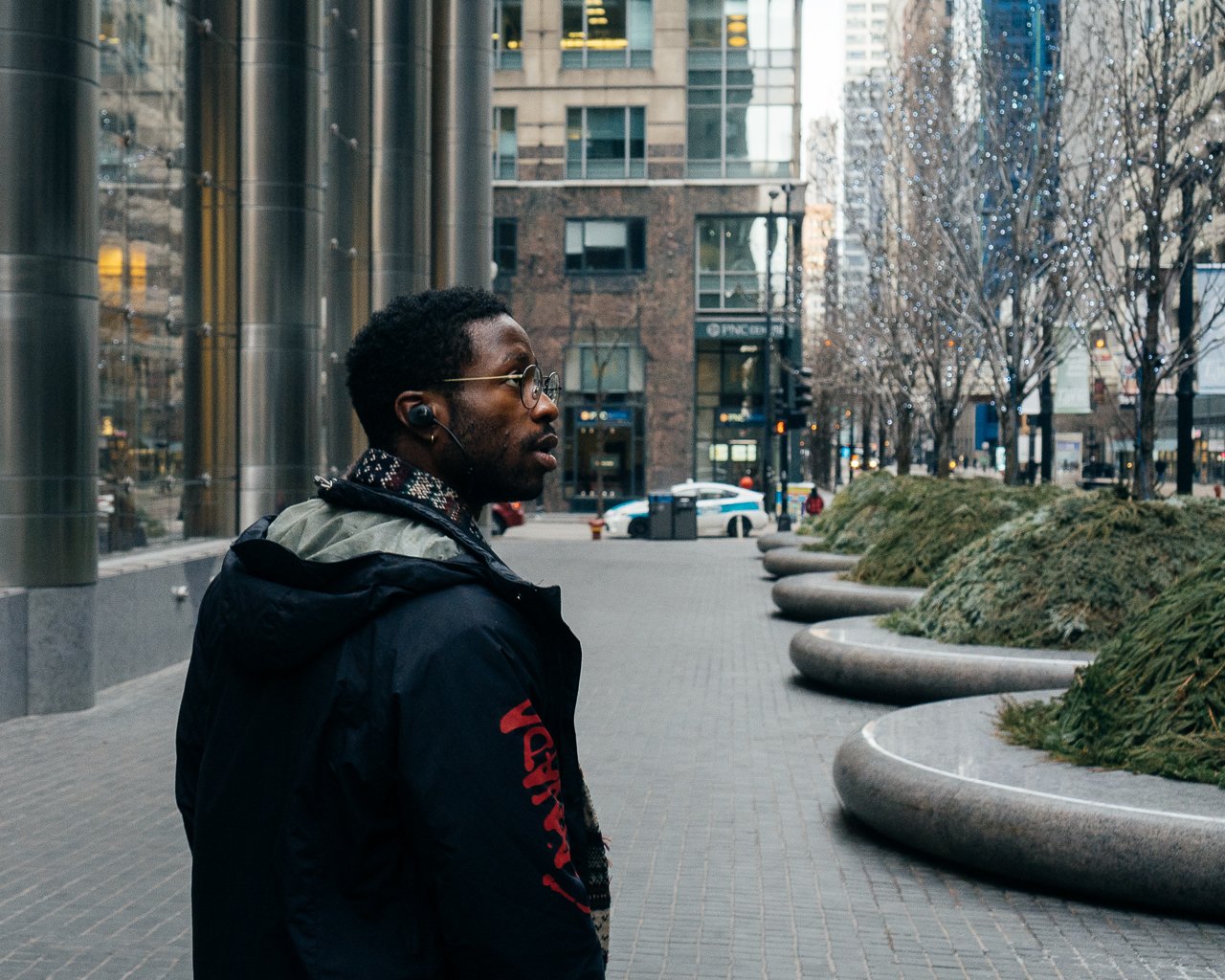
Photo by Funeh
about silent minority
I got interested in street photography because it allowed me to observe human behaviour and capture interactions among each other and with their environments. Between 2020 and 2022, when I started the Silent Minority, a fair amount of available street photography focused on protests. Protests against police brutality. Protests for and against vaccine mandates. Protests against government power, foreign oppression, and social injustice.
What stood out was not the cause. It was the certainty. Each protest split people cleanly into camps. Supporters and detractors. Right side and wrong side. Even private conversations with friends and family carried an unspoken demand for allegiance.
More striking was how consistently mainstream institutions aligned themselves with one side of each conflict. Media, tech platforms, government agencies, and workplaces. That position was framed as informed, tolerant, and virtuous. Since these folks can speak freely, that view is easily marketed as the side of the majority. The other position was reduced to ignorance or malice. In that environment, silence became the safest option for anyone whose views didn’t align cleanly with the approved narrative.
The Silent Minority refers to that group. I write as one of them.
These are people who choose not to speak publicly, not because they lack opinions, but because expressing them carries social, professional, or relational cost. Silence is not apathy. It is calculation.
Minority here most often refers to visible minorities, but not exclusively. It also includes minorities of opinion. Minorities within dominant narratives.
In North America, visible minorities are frequently treated as authorities on issues tied to the identity they are seen to represent. A Black person’s lived experience, for example, is often positioned as the final word in any race-related discussion, overriding analysis, comparison, or dissent. This dynamic allows the loudest voices within a group to define the narrative for everyone else who shares that label.
The same pattern appears in politics. Certain views become socially acceptable while others are driven underground. Public consensus forms quickly, not because agreement is universal, but because dissent carries cost. Support for unfashionable candidates goes unspoken until the privacy of a ballot box reveals a result that many claim to be shocked by.
These are different expressions of the same phenomenon. When narratives harden, silence becomes common. And those who remain silent are often mistaken for being absent.
As an immigrant from Nigeria, whose views often clash with what is expected of someone who looks like me. Friends and acquaintances have described my positions as inconsistent with my background. That reaction is understandable. We are repeatedly told that people within the same demographic category think, vote, and interpret the world in the same way.
I reject that premise.
This blog is a space to examine race, culture, politics, human psychology, and religion without flattening them into slogans. I am less interested in signalling virtue, rather in understanding incentives. Less interested in outrage than in tradeoffs. Less interested in winning arguments than in asking better questions.
Silent Minority is not a manifesto. It is a public record of thinking that I previously kept private. An attempt to replace journal entries and closed-door conversations with careful, open expression.
I don’t consider myself a writer. Yet.
But I do take ideas seriously. And I welcome disagreement from anyone willing to engage honestly and without caricature. Challenge my views. I intend to return the favor.
Thank you for reading. I’ll work to make your time here worth it.